Search This Blog

Tuesday, 30 March 2010

More Haste – Less Speed

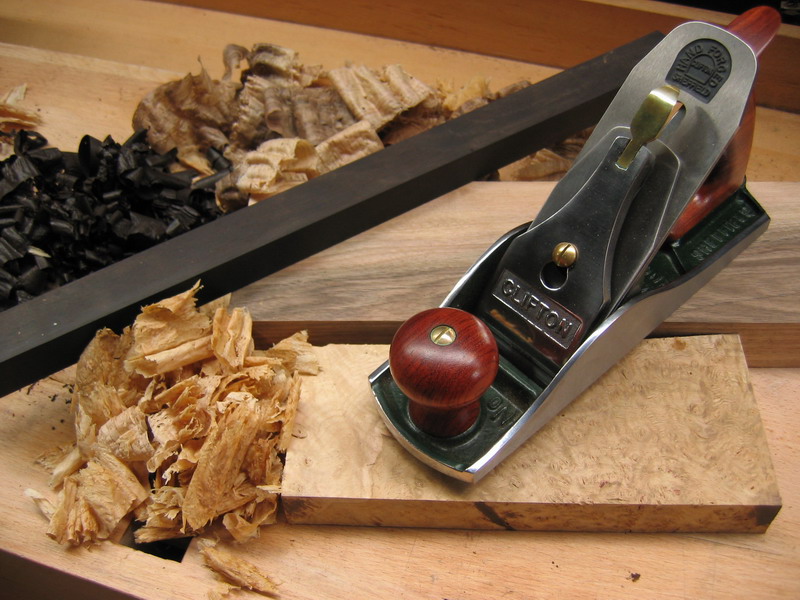
Clifton planing ebony walnut and oak

When you first start working with handplanes it is inevitable that sooner or later you will come across the problem of tearout. It is a common problem and every time you think you’ve cracked it another tricky piece of timber comes along that doesn’t want to play nicely. It usually happens because the grain of the timber is not all flowing in the same direction so the cutting edge of the plane iron is no longer cutting the fibres but instead is splitting them away from the surrounding material.

There are a broad range of weapons in the cabinetmakers arsenal to tackle this issue but it’s all too easy for experienced makers to omit the first and easiest way when they are advising others on how to tackle it, probably because they do it habitually and without thinking.
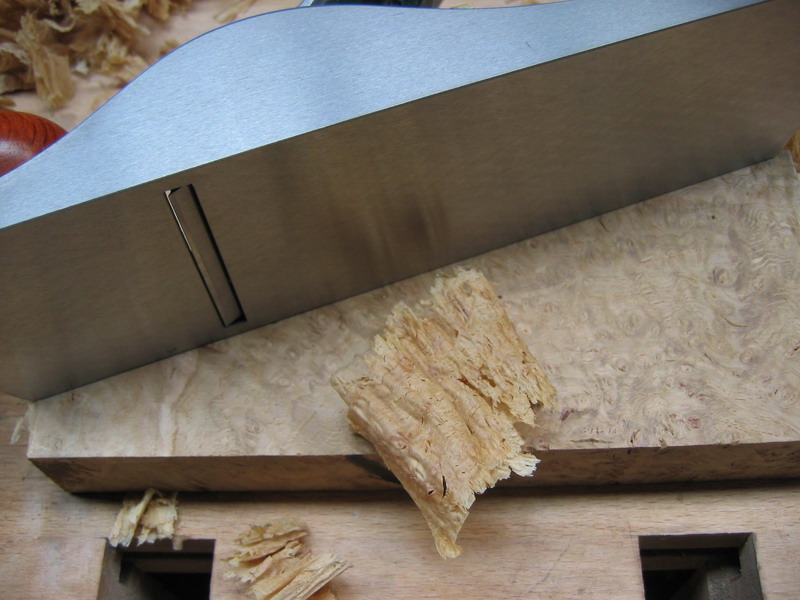
Clifton vs. Oak burr

Assuming your plane iron is sharp, the first port of call when you experience tearout is to slow down – right down. Nothing else changes, your stance, distribution of pressure on the plane, angle of the plane to the work, all remain exactly the same, you just take your good old time - perhaps ten seconds or so per foot of timber planed.

Observe the shaving as it emerges from the mouth, the shaving contains a wealth of information about what just happened at the cutting edge. Holes with flowing shapes and very thin frail edges indicate low spots, changes in the texture of the shaving indicate patches of reversing grain that the plane is coping with already and jagged holes with thick edges indicate areas that it is not coping with.

Quite often the simple act of slowing down is enough to either make the problem disappear completely or reduce it to a couple of thumbprint sized patches that can be cleaned up afterwards with a thin cabinet scraper.

The next simple step is closing up the mouth to a slit and backing off the depth of cut so that the plane is only just cutting, a really light wispy shaving invariably produces a finer surface finish than a thicker one.

Honing your cutting iron is the next step, as the first few passes with a freshly honed iron are much less prone to tearout. The final finishing passes on a piece of timber should always be taken with a freshly honed cutting iron, regardless of whether you only honed it five minutes ago or not.

Only when you have worked your way through the 'low hanging fruit' that requires no additional kit and the bare minimum of extra time should you start thinking about steeper pitches or scraping.

Thursday, 25 February 2010

Latest deliveries

Just a quick one to let you know that we recieved a delivery from Ashley Iles today. So if you have been hanging on for bevel edged chisels or a particular carving or turning tool, the chances are that we now have it in. Stock levels on the website will be updated within the next 24 hours.

The delivery also included the new Peter Benson 1/32" V-Tools, as advertised in this month's Woodcarving Magazine. As far as we know these are the smallest V-Tools ever made, perfect for details like the veining on feathers, fine hair and subtle foliage textures.

Also recently arrived are a small top up of Clifton no. 7s (already up) and a selection of lime carving blanks which will be photographed and listed over the next week or so. Our Clifton promotion finishes at the end of the month, so if you want to place an order for one at the sale price (regardless of whether it's in stock or not) please give us a ring and we can backorder it for you.

Monday, 15 February 2010

Micron Grit Conversion

Scary Sharpening Kit from Workshop Heaven

We have had a couple of questions recently regarding how the micron sizes used in our 3M lapping film equate to waterstone grits. Adrienne has done a little research and plotted the line of best fit between several sources (which were very close anyhow) and established the equation of the resulting line as 11139 times the micron size to the power of -0.9393!

I'm not sure if direct 'this = that' parallels are entirely appropriate in this case, my experience has been that lapping film produces a noticably finer surface finish than the equivalent waterstones. This may be a result of the particles all being extremely uniform in size, or the resin on the sheets being more durable than the clay of a waterstone.

Either way, here's the conversion table:

Micron to Grit conversion for scary sharpening

For abrasive film, an approximate comparison to European grits:

  • 5 micron is around P1200
  • 30 micron is between P400 and P500
  • 60 micron is around P240

If you are using the American grit system:

  • 5 micron is 1500
  • 30 micron is 360
  • 60 micron is between 220 and 240

Thursday, 10 December 2009

The Eagle Has Landed!

Finally! The first pallet of planes arrived today from Quangsheng and I have been busy unpacking and inspecting a sample of each type, taking photos, etc.

First impressions:

Better than expected - a lot better than expected; I was hoping for a budget alternative to the big three, a compromise that would suit folks with limited funds, something that would need less fettling than a vintage tool and might perhaps appeal to pro-cabinetmakers for rougher jobs like Jack planing.

What we have ended up with are a very serious range of tools indeed.

My concerns about the irons were completely unfounded, they are beautifully ground, rock hard and take that spine chillingly sharp edge that you only get with properly heat treated carbon steel.

Quangsheng plane

The machining on the bodies is excellent, I stripped a low angle rebating block plane this afternoon and put the sole up against a straight edge – a nice triangle of light between the mouth and the back indicating that the casting had been correctly pre-tensioned as it was ground. After re-inserting the iron and lightly nipping up the cap to working tension (less than half a turn past the point where the blade advance is free enough to work) the triangular gap was gone. It may not sound like much, but getting that just right is a really clever bit of metalworking.

I would have absolutely no qualms about putting these tools in front of some of the top cabinetmakers in the country, they really are that good.

So, perhaps we had better make that the big FOUR from now on!!!

Wednesday, 2 December 2009

Free Shipping Fortnight

Ordering early for Christmas makes our lives so much easier. So as a thank you to those who help us out by not leaving it until the last minute, we are offering Free Shipping on all UK orders, until the 14th of December.

Sunday, 22 November 2009

Sticker Shock !

I recently read a post on a forum about the gold stickers on Ashley Iles chisels. The poster said that he thought them unnecessary and that if anything they cheapened the look of the chisels.

I'm not overly fond of them either and there didn't seem to be any dissenting voices from people who particularly liked them, so I thought I'd experiment by removing them from the chisels that we send out for a while and see what the reaction was. - Nothing, no complaints, grumbles or comments whatsoever.

I mentioned this little test whilst on the phone with Barry at the Ashley Iles factory the other day and he said:

"Good! I've never liked those blooming stickers."

So, henceforth the Ashley Iles Cabinetmaker's chisels, Butt chisels and Dovetail chisels made for Workshop Heaven will be produced without stickers.

Job done!

Footnote: The Ashley Iles Cabinetmaker's Chisels are available with beech handles for a limited time, I haven't had time to take photos but if you want them in beech just drop me an email.

Friday, 13 November 2009

Quangsheng Planes

Quangsheng block plane

Today we have made the final payment and received shipping information on an order of planes from Quangsheng Tools in China. We have been looking for an acceptable range of budget handplanes for a couple of years now, and after six months of intense questioning these guys seem to have come up with the right answers.

The planes were originally developed with the help of Woodcraft in the USA, where they are marketed as Wood River planes. Unusually they are cast from steel rather than iron, a very good but expensive way of doing things that I had previously thought to be the preserve of infill planes. I asked for a copy of the specs and it is a low carbon steel (anything under 2% carbon is steel) with a high chromium content so it should have reasonably good corrosion resistance too.

Quangsheng plane spec

I also asked about their grinding and was told that they anneal the castings before grinding them and was sent this photo showing a nice big solid bed grinder - important as it acts as a heat sink as well as pretensioning the body and holding it absolutely rock steady as it passes under the grinding wheel. A steady flow of coolant again reduces the chance of the body being stressed by the introduction of heat.

Quangsheng plane manufacture

For the handles I have opted for Chinese grasstree wood, they also offer rosewood handles which they apparently buy in from England. From an environmental perspective I couldn't justify using a far eastern timber that has been transported here, shaped, sent all the way back to China and then brought all the way back here again, it seems ludicrous. So the stuff that is local to the place of manufacture, and apparently grows like a weed seemed by far the best bet, I have used grasstree handled tools before and although somewhat plain, it is stout and perfectly acceptable.

The one thing that does concern me is the use of T10 (the Chinese equivalent of W1) for the irons, this can vary hugely depending on the heat treatment, specifically the hardness of the water that is quenched in. Soft water does lovely things to tool steel whilst hard water tends to do the opposite. I haven't been able to find any definite information on the hardness of the water where they are made so we shall just have to wait and see. If it comes to the crunch we can always replace the blades or re-do the heat treatment.

The big question now is how fast TNT can get them here. They rather unhelpfully quote 10 days plus, which could mean anything.

*Update* We have upgraded the shipping option so they should be here at the beginning of December, just in time for Free Shipping Fortnight!!!!

Monday, 9 November 2009

West Riding Woodcarvers Association

I was chatting with a customer from Yorkshire recently. He lives just down the road from Richmond, where the HQ and museum of my family regiment is housed in a beautiful old church, I was reminded of taking the train up there as a mustard keen 19 year old for an interview with the Regimental Secretary. Anyway, the conversation turned to carving clubs and he mentioned that he was a member of the West Riding Woodcarvers Association.

The club is currently working on a series of carved panels depicting scenes from the first and second world wars which will eventually be displayed at the Royal Armouries in Leeds. Each member takes a pre-sized block of timber and a design and carves it in their own time, the whole is then assembled and displayed. The club have already created similar panels for several local hospices which are donated free of charge and have earned them royal recognition in the form of a Queens Award for Voluntary Service.

As well as providing an enjoyable project for the club members, the panels add warmth and interest to the environment in which they are displayed in a way that a two dimensional image couldn't match. They also serve to draw public attention to both the club and carving in general.

I believe this is a fantastic way for carvers to help their local communities and bring a touch of warmth to people who so desperately need it. Another amazing thing that we can all do at this time of year is fold up a donation, drop it in the tin, and 'wear your poppy with pride'.

By the way - a wee dab of superglue is all it takes to keep the leaf in the correct position and stop you looking like a politician.

Monday, 26 October 2009

It's all coming together!

Christmas at Workshop Heaven

I absolutely love this time of year, there is so much going on. It's like the point in a run where you have just broken through 'the wall' and seem to be pulled along by a wave of momentum.

Christmas is a real make-or-break time for us and the work that began at the end of August is now coming close to fruition. Thankfully this year we have had a very strong third quarter, so cashflow for Christmas stock is much less of a concern than usual.

Around now we start receiving stock deliveries from our suppliers. All the new products have to be photographed and listed, the magazines need artwork for the Chistmas advertising campaign and in the warehouse there is lots of work to do pre-packaging kits and making room for new lines (including selling off all the odds and ends on the Workshop Heaven ebay shop).

The C.I. Fall bevelled firmers are already up on the website and the first of the morticers will follow shortly. The new Famag carbide tipped augers and Forstner bits are up as well and we have just added new website sections for Christmas gift ideas and stocking stuffers.

A huge box arrived this afternoon from Mora of Sweden with lots of new knife blades and assorted goodies and we are eagerly awaiting a pallet of planes from Quangsheng Tools in China (don't worry we won't be trying to fob anyone off that they are American!). They have however been developed in close conjunction with Woodcraft, who are American, and are tipped to be reasonably good copies of early Stanleys made in cast steel, bronze and brass. Combined with a selection of optional upgrade plane blades by Ray Iles I think they could prove quite popular.

At the same time there are family traditions to keep up with as well - last weekend we got together with some mates and pressed a batch of cider for Christmas 2010, I reckon 80 gallons should be about enough to slake our thirst from next year's Christmas campaign!!!

Thursday, 8 October 2009

Stamjarns and Teardrops 2

new chisel handles

At the end of last week two big parcels arrived from Sheffield full to the brim with beatifully turned beech teardrop handles. I have some wallets on order for the individual ones and our French suede tool roll supplier was finally able to make a delivery last week as well, so I've got something to put the sets in too. The latest batch of rolls are a tadge lighter in colour than the old ones but still a superb example of hand workmanship.

I wasn't happy with the grinding on the morticers, so I reground a sample and sent it off with a couple of originals to a very talented bladesmith in Scotland called Chris Grant. We'll see what he comes up with but I've got a feeling it will be rather good!

The finishing on the bevelled firmers is still not perfect but bevelled firmers were never intended to be used for fine joinery, they are supposed to be affordable general purpose chisels that can take a bit of stick.

With Chris sorting out the morticers and John sorting out the wallets, I can get on with the finish for the handles. I tried about a dozen different finishes but the winner by a country mile was oiling with sun bleached Swedish linseed oil, followed a couple of days later with pure beeswax polish. I use 25% first grade Cornish beeswax and 75% natural pine turpentine warmed in the sun until the two blend together. It brings a warm golden hue to the timber and a really comfortable feel in the hand. The turpentine is also Swedish - distilled from pine roots - so even the finishing has a strong Swedish element and reflects the Swede's passion for nature and aversion to unnecessary complexity.

finished chisel handles

Here's the first batch after handling and finishing, 120 down and about 500 to go!