Search This Blog

Thursday, 27 November 2014

DVD Review: The Secret Mitre Dovetail - David Charlesworth

David Charlesworth - The Secret Mitre Dovetail

I must preface this review by saying that I have watched David's new DVD once, from beginning to end; but this is not how I prefer to enjoy them. A Charlesworth DVD should be savoured slowly, a little at a time, interspersed with visits to the workshop to try the techniques for yourself and reinforce your understanding of them.

The first word that springs to mind after watching is richness - The DVD for its richness of content, and the man for his richness of experience and his well practiced ability to share such deep knowledge efficiently. This effortlessly smooth production has been a lifetime in the making - savour it, give your brain time to absorb the finer subtleties and nuances.

Like most of us, I have several woodworking mentors and admire them for different things, for example I find Tom Fidgen's working rhythm particularly graceful and Mark Fish's creative vision awe inspiring.

For me the thing that marks David out as a teacher and a woodworker is his application of academic rigour to the process of 'making as perfectly as possible'. He explains the thought process behind his approach to each task, then demonstrates it, explaining clearly what you should be looking out for at each step.

There is also a humility that is a characteristic common to both good craftsmen and good academics, David is laying his course of bricks in the cathedral of knowledge that is the craft, with openness about his own strengths and weaknesses and full accreditation to those who laid the previous courses - Robert Wearing, Alan Peters, Ernest Joyce et al.

With very few exceptions the filming and editing are of BBC documentary quality throughout the 2-3/4 hour run time, the DVD is conveniently edited into chapters so you can use it as a reference text.

Nominally the DVD is about cutting a secret mitre dovetail, but if that is all that you glean from it you have missed about 90%. All of the techniques demonstrated have much broader application and along with their entourage of analytical thought processes, will enrich your woodworking enormously.

The DVD costs £29.95 and is available directly from David's website here: The Secret Mitre Dovetail - David Charlesworth

Wednesday, 5 November 2014

Clifton Planes

Clifton Planes

OK, I admit it, I was somewhat surprised when Thomas Flinn & Co took over ownership of Clifton last month and immediately replaced the classic British racing green colour with graphite grey.

From a future historians perspective it will certainly provide a clear demarcation of which planes were made on whose watch, but surely, Clifton without green.....?

Workshop Heaven has a long affinity with Clifton planes, they were one of the first brands that we stocked and I have visited the factory and chatted with the guys who make them, written magazine articles about their manufacturing methods and used them in woodworking projects.

I also have a long standing relationship with Thomas Flinn & Co, who manufacture our Pax saws and (coming soon) Dorchester saws. They too are a highly professional outfit with an unquestionable passion for Sheffield toolmaking, so I made the decision to reserve judgment until I had the opportunity to physically hold the product in my own hands.

Clifton Planes

That day has come, so it's time to put my beloved original 2001 No.6 alongside its 2014 descendant and draw some conclusions.

The first thing I noticed was that the lettering is much more visible on the new lighter colour, the surface is considerably smoother and it is clear that they have taken expert advice and invested in a premium quality finish.

But what of the colour choice itself?

For me the green was reminiscent of 1920's vintage Bentleys, soaring around the banks of Brooklands with a screaming supercharger hanging out at the front, good old British engineering giving all comers a proper thrashing!

The graphite strips all of that away: it is utilitarian, industrial, almost naked, really beautifully done but devoid of any emotional message at all.

At the same time though, that very nakedness forces you to look beyond distractions like colour schemes or suggestive marketing and appreciate the tool for what it actually is - modern British engineering - still giving all comers a proper thrashing!

Clifton Planes

Personally, I'm a convert, and my enthusiasm for the new colour scheme is growing by the minute, the graphite colour brings the product range up to date but in a subtle, refined way that accentuates their world renowned quality.

Rumour has it that there are some very interesting goodies in the pipeline from Clifton, but it would be a bit premature to comment on those just yet...

The first Graphite Cliffies are now on sale, the remaining green ones are available at specially discounted prices in order to help us achieve a nice efficient switchover. As soon as we have a complete set of graphite ones we will update the listings with new photographs, pricing etc, but in the meantime please assume that non-discounted ones will be supplied in graphite.


Clifton Planes

Tuesday, 5 August 2014

The No.8 Jointer Plane

Quangsheng No. 8

Let's not beat about the bush, the No.8 Jointer is a big handplane. Twenty four inches long and just a pinch over 3 inches wide with a broad 2-5/8" cutting iron. It is also one of the most widely misunderstood. If you try to use a No.8 like a 'go-to' everyday plane for stock removal you will end up exhausted and frustrated in a matter of minutes. Like the smoother, it a dedicated tool for a specific task, in this case, accuracy (and therefore speed).

With its wide blade, the No.8 is wonderful for getting large surfaces truly flat, but to understand why, it is easier to consider it's main function - edge jointing.

Quangsheng Plane Irons
Irons from No.4 (top) No.7 (middle) and No.8 (bottom)

Imagine you are planing the edges of a pair of ten foot long boards to glue them up for a tabletop, wardrobe door etc. You have the boards in the vice back to back, or face to face, in order to eliminate the need to worry about keeping the edge square (if there is a low side on one there will be a corresponding high side on the other that cancels it out), so all we need to do for a perfect fit is get them straight in their length.

You always approach flat from concave, so we need to hollow the surface by taking stopped shavings, beginning with the cutting edge on the surface and lifting off before you reach the end. When the hollow becomes greater than the depth of cut over the length of the sole, the plane will cease to cut.

Switch to full length cuts and the plane will take a shaving only at the beginning and end of the board, successive pairs of shavings will get progressively longer until they join up. With the first continuous shaving the edge is straight.

The advantage of a really long plane is that it produces a shallower hollow, so you can straighten an edge or level a surface more accurately, and in fewer passes, than you would be able to with a shorter one.

Quangsheng No. 8 Jointer Plane

The image above is a complete hoax, I planed the edge with a No.3 smoothing plane and then a low angle block plane to make the hollow big enough to see (about 1/8" or 3mm), but it illustrates the point. With a finely set No.8, the light gap under the sole would be two or three thousandths of an inch. Because the reference points at the toe and heel are further apart (forming the chord of a bigger circle), the hollow created is shallower and therefore takes fewer passes to establish and fewer to remove. The longer the board, the more time you save - exponentially.

In a collective workshop you could easily get away with one jointer plane as a workshop asset between half a dozen makers, and even then it wouldn't see daily use. But when used appropriately and with due respect for its size, the 'big gun' can make extremely short work of getting large surfaces very flat, and pairs of long edges up to 5/4" thick, very straight indeed.

Quangsheng No. 8

Friday, 25 July 2014

New English Workshop Summer School with Christopher Schwarz

Today I visited Warwickshire College and the first ever New English Workshop Summer School, where 18 worthy souls are building 'the Anarchist's tool chest' under the expert guidance of Christopher Schwarz.

Despite 30 degree temperatures, the team spirit and general camaraderie of all involved was overwhelming; people are waiting at the door to get cracking in the morning and have to be reminded to stop and eat!

The tool chest is a wonderful project, nothing incredibly complicated, so any one element is straightforward to grasp and master. However, it is the way that those individual processes build upon each other that is so important. It teaches you how to develop your working rhythm, working steadily and hard, but taking enough time that you don't make mistakes. Concentrating on the task at hand, but maintaining an overview of the build - it is a complete process.

I was lucky enough to get a chance to get my hands dirty, helping out with shooting some boards to length and cutting a few dovetails. It was interesting to get a feel for what it is like to work in a crowded bench shop - hot, loud, but hugely rewarding.

Chris's reputation as a teacher is is well deserved, he has a habit of explaining something perfectly in nine words that most people would struggle to get across in ninety.

This example from the New English Workshop blog:

"Chris uses the three terms, Baby Bird, Locomotive and Hovercraft to describe how you should be sawing: hold the handle as you would a baby bird; strong enough to not let it get away, gentle enough not to crush the bird. You move the saw just as a steam locomotive’s wheels are driven and finally, when beginning the cut you hold the weight off the toe of the saw by using the lower horn to lift the toe (when starting a cut). All of this leads, ultimately to better controlled cuts for our dovetails."

The concept of New English Workshop is to bring together the best that the craft of traditional furniture making has to offer and give people an opportunity to dive in boots first and give it a really good try. The 2014 courses sold out in a heartbeat, but there are some seriously fantastic courses planned for summer 2015.

If you want to get a place on one, visit New English Workshop, sign up for more information and start saving. Once the 2015 courses are announced they will be snapped up, so you'll need to be prepared.


Friday, 6 June 2014

Small Fish, Big Ocean

Britain's crafts industry may not be regularly slathered in the obscene dollops of thick creamy funding that is applied the arts, but that's not necessarily a bad thing. Exposure to market forces makes craftspeople stand on their own two feet, they become sharp, streetwise, attuned to their economic circumstances, and critically, better able to adapt when those circumstances change.

In the years since 2008 our economic circumstances have changed enormously. The banks currently borrow our taxes from the government at 0.5% and lend it back to us at 12% or more (as long as you are willing to bet them your family home that you can pay them back that is). If the price for putting a roof over your business and the price of oven ready chickens had kept pace with each other over my lifetime, chickens would now cost just under £50 each. This isn't just the normal ebb and flow of markets, it's a full on sea change. So how are the people who make high quality useful objects responding?

It is perhaps fitting that craftspeople are reverting to type and following nature's example. If you feel like a small fish in a big ocean, you do what the small fish do - swim together!

Collective workshops are now undoubtedly the future of the British craft industry. Vale Lane Workshops in Bristol are a perfect example of the direction the industry is now taking. Ten exceptional craftspeople sharing one workshop, with shared access to wonderful kit, bench space, each other's enthusiasm, and a single beautifully presented and promoted website with everyone's work on display. They have divided all the costs and multiplied all the benefits - finding genuine economic and creative synergy in the process.

The way in which craft businesses are funded is also changing massively, peer to peer lending is rapidly taking over from the high street banks as the first port of call for small businesses. You typically get a much better rate, you are helping individual savers to achieve a realistic return on their savings, the interest you pay is determined on a case by case basis by auction, and to an extent you are also gaining exposure to potential new customers.

For centuries the key to success in the crafts has been patronage, clients who will give you a one word brief and trust in your vision and creative spirit, then having paid for the piece, allow you to borrow it back again to exhibit and drive further commissions. It can go wrong, (Thomas Chippendale being the oft quoted example) but for the most part this arrangement works for both parties. The patron becomes the owner of a famous and widely exhibited piece of furniture, and is admired for having spotted the potential of the maker. Whilst the maker gains exposure, both through the patrons acquaintances and through exhibiting their past (and paid for) work to the public.

Tuesday, 22 April 2014

Designing Exceptional Furniture

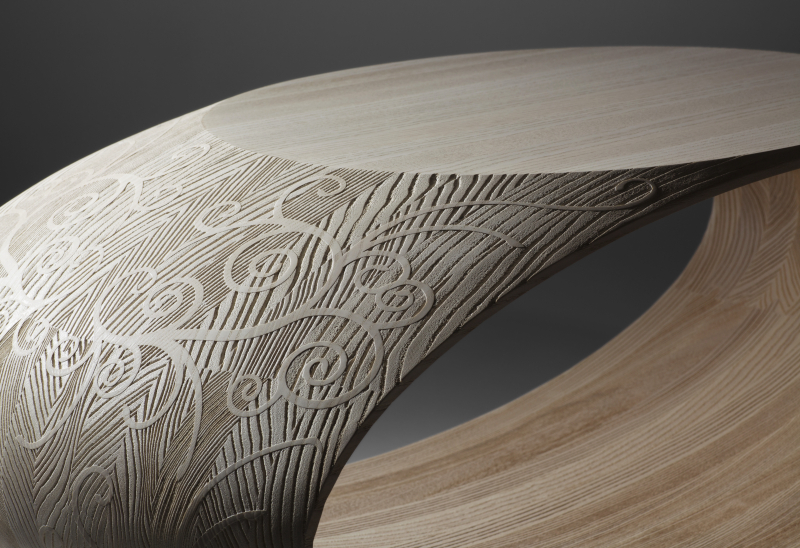
If you want to understand how to balance form, texture and colour to absolute perfection, study the work of Irish designer maker John Lee.

The difference between good furniture and truly exquisite furniture is the way that these three factors work together. In the example above, the oval form of the table and the highly detailed carved texture on the outer surfaces are very strong. To balance the strength of these two elements, he has bleached the colour out of the timber and incorporated crisply finished plain surfaces as a foil for the intricate carved work. The result is a perfectly mixed cocktail for the eyes.

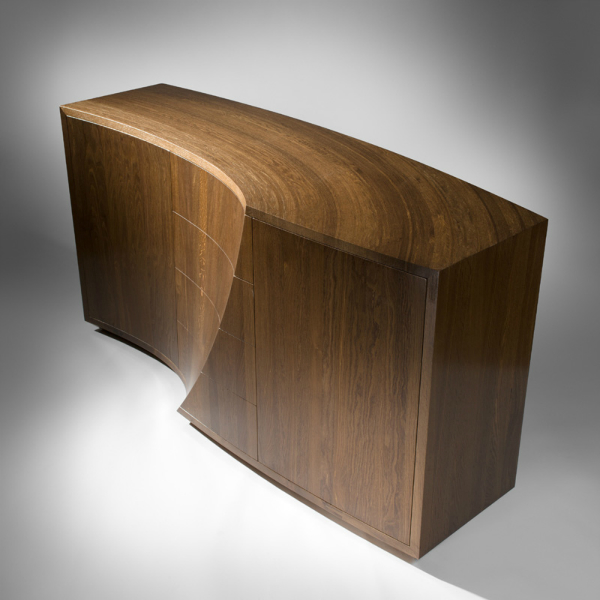
Form is used again in John's wave sideboard, but this time the figure of the oak, enriched by fuming, provides all the surface interest you could ever need. The sweeping curve in the grain of the top panel leads the design, careful selection and orientation of the timber for the doors and sides harmonise with it, and the flare through the drawer fronts brings the whole design to life. The surfaces are all smooth though, no texture, no drawer pulls, just form and the natural figure of the timber.

Choosing two of the three elements to accentuate and then downplaying the third will make your furniture more aesthetically appealing. Scale and proportion are also important considerations, but these can be achieved mathematically. Following the work of one or two really good designers and seeing how they carefully balance the different elements to maximise the visual return from both materials and making time is the best way to develop an understanding of how good design works.

Friday, 4 April 2014

The last of their kind...?

If you thought a Messerschmit was an aeroplane and a Fassbender was an actor, think again.

The fantastic Bayerisches Fernzehen (Bavarian Telly) series 'Der Letzte seines Standes?' is now available on youtube. It's all in German - naturally, but you don't need to understand the words to enjoy the skill and craftsmanship.

The series is a feast of handcrafts, with different episodes covering everything from knifemaking (messerschmied) to Coopering (Fassbinder).

Grab a brew and enjoy...


The full playlist is available on YouTube.

Wednesday, 5 March 2014

Cheating death with a Moxon

second hand moxon vice

I recently acquired a secondhand demountable Moxon vice with the intention of doing away with the back part and installing it permanently in place of my traditional front vice. It may not be as pretty as David Barron's beautiful bench-crafted version, but with a bit of common sense and elbow grease...

treat the woodworm

The first job was to treat the woodworm to long cool drink of Rentokil. In fairness I think they were probably long gone already, but with the dreaded beetle grubs it always pays to be safe. A quick soak in the bucket of Restore Rust Remover brought the metal parts up nicely.

de-rust the metal bits

Not so lucky with the wood though, a few swipes with a Clifton smoothing plane revealed that a little bit of rot had also begun to set in to the beech components, which caused me to have a bit of a re-think about how best to proceed.

plane the wood

By the end of the first cup of tea I had reasoned that installing it in place of the current front vice was folly, none of the holes lined up nicely and I didn't really want to block up any dog holes. By the end of the second cup it occurred to me that if I installed it on the other side of the bench instead, I could:

  1. Bury the manky beech components inside the bench top.
  2. Make a nice smart new jaw of whatever length I wanted.
  3. Keep the front vice too.
  4. Fill in that flippin' 'tool well' for good.
  5. Gain an extra 3 inches of work surface.
bring out the oak

Out with the oak! This piece of oak comes from a stack that my Grandad acquired from his neighbour who died before he could use it. Grandad never used it for anything and then died, Dad inherited it, never used it, and then he died too; leaving it to me. Dad's brother (who pointed this pattern out to me) made a nice garden bench out of the bits he got from Grandad and he's still very much alive and kicking...  Hmmm, I wonder?

sawing the oak

With the oak planed up and trimmed to length, I set about tidying up the tool well, (another shoulder plane job that isn't a tenon shoulder). You can angle it down so that the nose of the plane gives a reference for square against (in this case) the bottom of the well, and just trim away until the bump is removed.

another shoulder plane job

The holes in the jaw were drilled on the drill press (with a FAMAG bormax naturally) and then clamped in place and used as guides to position the holes in the back of the tool well.

FAMAG Bormax forstner bits

First trial fit with the original wooden components screwed in place to reinforce the back. I will probably need to thin them down a bit to make space for a reasonable thickness of top surface. I've got a lovely thin board of elm that would be perfect for that job if I can only remember where I've put it.

the finished product

The ability of the Moxon vice to accept wide boards, grip like a Yorkshireman holding a fiver and only rack horizontally when you want it to, makes it a valuable addition to your clamping arsenal. With a nice leather lining and the bench filled in behind it I am sure it will do valiant service.

I now also now realise how much I like having a vice that finishes flush with the right hand end of the bench for sawing. Am I the only one who finds that the traditional front vice on the left arrangement works better in theory than practice?

Thursday, 16 January 2014

Anarchy in the UK

New English Workshop is not a company, nor is it a charity or a guild, it's one of those wonderful collective momentum things that just happen because enough people think it's a brilliant idea and offer their support.

The concept: to enrich the craft of fine furniture making by promoting and encouraging traditional methods through training and education - is entirely wholesome and the more I learn about it the more convinced I am that it will be an unparalleled success.

They are not going about this lightly; the first New English Workshop project is a summer school to be headed up by hand tool woodworker, author and teacher Christopher Schwarz from the United States and centred around his book The Anarchists Tool Chest.

The venue, Warwickshire College, is centrally located, well equipped and has an admirable reputation for producing first rate furniture makers.

The summer school is scheduled to run from 21st - 29th July.

21st - 25th Anarchist's Tool Chest

28th - 29th Dutch Chest

The Anarchist's Tool Chest

If you would like to register an interest in attending, or be kept abreast of new developments, follow the link below to the holding page and drop them an email. You may not get a reply immediately but will be contacted as soon as further information is available. A facebook page and New English Workshop blog will follow shortly, we will be adding links from this page as soon as they are published.

The Anarchist's Tool Chest

Updated 28/01/2014

Here are the links for the N.E.W. website and blog:

Website
New English Workshop Website

Blog
New English Workshop Blog

Tuesday, 10 December 2013

Hand Smythed Saws

best woodworking saws UK


Every week I get emails from far eastern circular saw manufacturers asking if we are interested in selling their saws. Every time the answer is the same: Thank you but we are very happy with our current supplier.

The reason for this is that there are only a handful of manufacturers left in the world who still smith and tension their blades by hand, and the product is inherently superior. Of those few companies, only one has a fully comprehensive range and the facility to manufacture special orders for us. They are based in Sheffield, so the industrial quality saw blades can periodically be sent back to the factory, re-sharpened on the machines that made them and have their tension and balance checked by one of the smiths that made them. These are not throwaway consumable items, they are proper tools, built to last.

When a circular saw blade is stationary there is no way that an untrained eye would be able to tell a hand smythed saw from any other, the difference is hidden within the metal of the saw plate.

If you imagine a circular saw in use, the perimeter is being heated by the friction of cutting the wood whilst the rest of the plate is being cooled by airflow. If you use just any old piece of steel, the opposing forces of expansion and contraction distort the saw plate and turn into the shape of a Pringle's. As soon as it cools down, it will return to flat.

With a hand smithed blade, the effects of the working loads are balanced by the tension in the saw plate. The only difference between working and stationary is a tiny increase in the diameter.


The process of making a handmade circular saw begins with the heat treatment, best hot rolled plate steel that has been laser cut to shape is annealed and then heated and quenched in a special press. This process makes the crystalline structure of the steel form correctly - so that the blade naturally wants to be flat. It is then tempered back to the correct hardness under the weight of a full sized millstone.


The heat treated saws make their first of three visits to the smithing shop, where a time served (5yrs+) saw smith tensions the blade using a selection of hammers and a special straightedge. Until recently the craft of saw smithing was a closely guarded secret, the only people who ever saw the work being done were either qualified smiths or apprentices.

The processes of grinding the saw to thickness, brazing on the massive carbide tips and then shaping and sharpening them are all done by state of the art computer controlled machines to an accuracy of 1/100th of a mm.


Each saw goes back through the saw smiths shop after brazing, so that the tension of the plate can be checked and adjusted if necessary. If you see any small hammer marks on the surface of a blade they will either have been made at this stage or the final check before the blades are passed as finished.

With a reasonable quality woodworking machine and the correct blade selected for the job, the stability and accuracy of a hand smythed industrial circular saw blade are unsurpassed.

If you would like to experience a proper hand smythed blade on your saw, they are available in sizes from 80mm to 915mm, with toothing patterns to suit all applications and centre holes bored or bushed to order.  

Workshop Heaven discount code AWWH25 will save you 25% on all industrial quality re-sharpenable saws, the same code can also be used for high quality, non-resharpenable, single life pro-trade blades.