Search This Blog

Thursday, 28 October 2010

Supersize Me!

Narex mortice chisel in use


The new 12mm, 14mm and 16mm Narex mortice chisels arrived the other day (along with some new sizes of the Narex bevel edged chisels) and being an inquisitive sort I had to have a play!

I had expected the 16mm mortice chisel to be a bit of a brute to wield, it is after all an enormous chunk of steel, but in its working position the weight is all borne by the workpiece. Making the initial cuts with the blade pinched low down between thumb and forefinger, you can feel the chisel start to 'swoon' if you get too far from vertical, when it feels weightless, you know it's perpendicular.

The intial cuts suggested that making progress wasn't going to be a problem, 3mm at a time into English walnut with nothing more substantial than a sharp tap with the mallet.

Having cleaned out the first layer of chips to create the shoulders of the mortice I moved on to heavier blows and the chisel just ate its way in. A handy tip I picked up from Jacob Butler is to chop through the waste rather than trying to clear it as you go. This saves a bunch of time and preserves the shoulder as all the force is going downwards. The chips gradually get more and more finely chopped too, so most of them will fall out when you turn the workpiece over and give it a sharp tap on the bench, especially if you made a cut lengthwise through the middle of the waste with a broad bevel edged chisel first. What little did need levering out at the end was done by using the kevlar reinforced head of the clamp as a fulcrum, again to preserve the crisp finish.

Considering that this was all done with the factory finish on the cutting edges I was pleasantly surprised and impressed with both the efficacy of the tool and the results. A little judicious honing of the primary cutting edge and the first inch or so of the sides will no doubt yield further performance.

If you haven't tried cutting mortices by hand I can thoroughly recommend it. Morticing machines have their place and if you are doing production work they are invaluable, but if you are only doing a few slots to cut then chiselling them is a quick, inexpensive and rewarding alternative.

Tuesday, 26 October 2010

Sneak Previews

Our New Continental Hand Stitched Rasps will be available shortly, there has been a minor delay as we altered the handle design slightly at the last minute. That said the results will be beautiful and it's better to get them absolutely spot on from the outset than rush them through and have to make changes later.

The new range of Narex Cabinetmakers Chisels are in production and will be available shortly. The edges are finer than the originals and the backs are correctly hollowed by around 6 thou in the length so they are very quick to prepare using 100 micron film and rapidly come into tolerance for fine work. The steel is the same bainitic chrome manganese steel used on the originals, austempered to RC59 for a deep even hardness and very high strength. The handles will be hornbeam, stained black with gold lettering and brassed ferrules.

Coming soon - the new Quangsheng Low Angle Jack Plane! This is the first photo we have of this new addition to the Quangsheng range and although it's unlikely to be here in time for Christmas, I'm sure it will prove to be a very popular tool.

The mouth is adjustable by means of a movable front sole, and depth of cut adjustment comes courtesy of a smooth and precise V2 mechanism similar to that found on the new Quangsheng block planes.

Wednesday, 13 October 2010

New Quangsheng Bench Planes

Quangsheng planes

The new Quangsheng bench planes are now available and will completely replace the original versions once existing stocks run out. The pressed steel lateral adjuster has been replaced with a fabricted one made from steel and brass with a guide bearing. The yoke that advances the iron is a little more meaty and we have switched from grasstree handles to Chinese rosewood. The lever cap is cast stainless with a fine brushed finish. We have stuck with the original 40cr cast steel bodies and T10 cutting irons as we believe that they are more highly specified than any of the alternatives.

Quangsheng bench plane

Wednesday, 6 October 2010

Time well spent

Time spent with good friends around a fire is invariably some of the higest quality time you will spend in your life. If you happen to poke a few bars of really nice steel into the fire and then bash them around - well, lemmetelya, it just gets better and better.

We popped in to visit custom knifemaker Chris Grant on the edge of the Cairngorms this week and once we had got over the spectacular scenery:

We settled into a couple of evenings of hard but rewarding prototyping. This is both enjoyable and really hard work at the same time. Commercial decisions need to be made on the spot and although the results can be seen almost immediately, time is very limited so the pressure to get those decisions right every time goes through the roof. It's a mentally demanding process but the results are well worth a thousand mile round trip and a spot of pressurised thinking.

First up was an idea that I have been mulling over for some time - a marking knife that can be presented perfectly flush to a left or right corner and naturally balances correctly in either position, can be rolled or drawn over an edge or surface and is possibly the wierdest looking but simultaneously the most 'now why didn't anyone else figure this one out before' idea that my twisted mind has ever wrought. Can it be made commercially? I have no idea as yet, but seeing the idea fleshed out in both O1, piano wire and cut-throat razor steel certainly brings things a step closer.

Yes, the photo doesn't give much away - but at this stage of production it would be foolish to do so. Suffice to say I am very excited about bringing this product to market.

Next was a forged carving knife for green woodworking - we used the same razor steel for this and it takes probably twice the effort to forge that O1 would (guess who was swinging the hammer to get this one from round to flat) - "s'your spec pal, you've tae bash tha bugger oot!!!" People talk about steel 'flowing under the hammer' well this stuff flows like a glacier on a cold day, even at 900 degrees C, but it was well worth breaking a sweat over - I have seen edges that would slice free hanging tissue paper before but it's still very impressive. The next step would be ball bearing steel which is only just forgable by hand if you've got really big arms and a chip on your shoulder, but may just be viable under mechanised production. I've gone for the longest blade I thought was viable on the principle that you can always make things shorter, but we will see how it goes once it's handled.

While we were at it, I thought that the most ultimate, ultra-gucci spoon knife in the world would be a lovely thing to do, so here we have a differentially hardened white paper steel (which I also learned began as mass produced tamahagane) spoon knife blade, complete with hamon line. It was a right little tinker to make and took hours to get right but if your smith can knock one of these out you know you are dealing with someone who really knows their business, £125 a pop unhandled if anyone feels the need. Here it is roughed out and quickly etched to find the hamon, once fully polished I have no doubt that this will become one of my my most treasured posessions. I went for a longer shank than usual as this allows you to swoop in for the really low cuts that enable you to hollow oval shapes as well as circular ones.

Last of all was something for Her indoors, a stock removal Santoku from AE 1095/15N20 Damascus which turned out better than any of us could have imagined.

Stock removal is a cheaper manufacturing method than forging but more wasteful in terms of raw materials, forging would however have produced a larger blade. Nonetheless, this little chap will see some serious testing once it is handled and it will be enlightening to see how it performs as an everyday kitchen knife. Updates to follow.

Chris is shortly going to be moving workshops, so if you want anything made it's probably best to be both quick in placing your order and prepared to wait a while for it. I can however give my personal guarantee that he will stop at nothing to ensure that the quality of your finished item is second to none in the world.

Saturday, 25 September 2010

Quangsheng V2 Block Planes

Quangsheng block planes

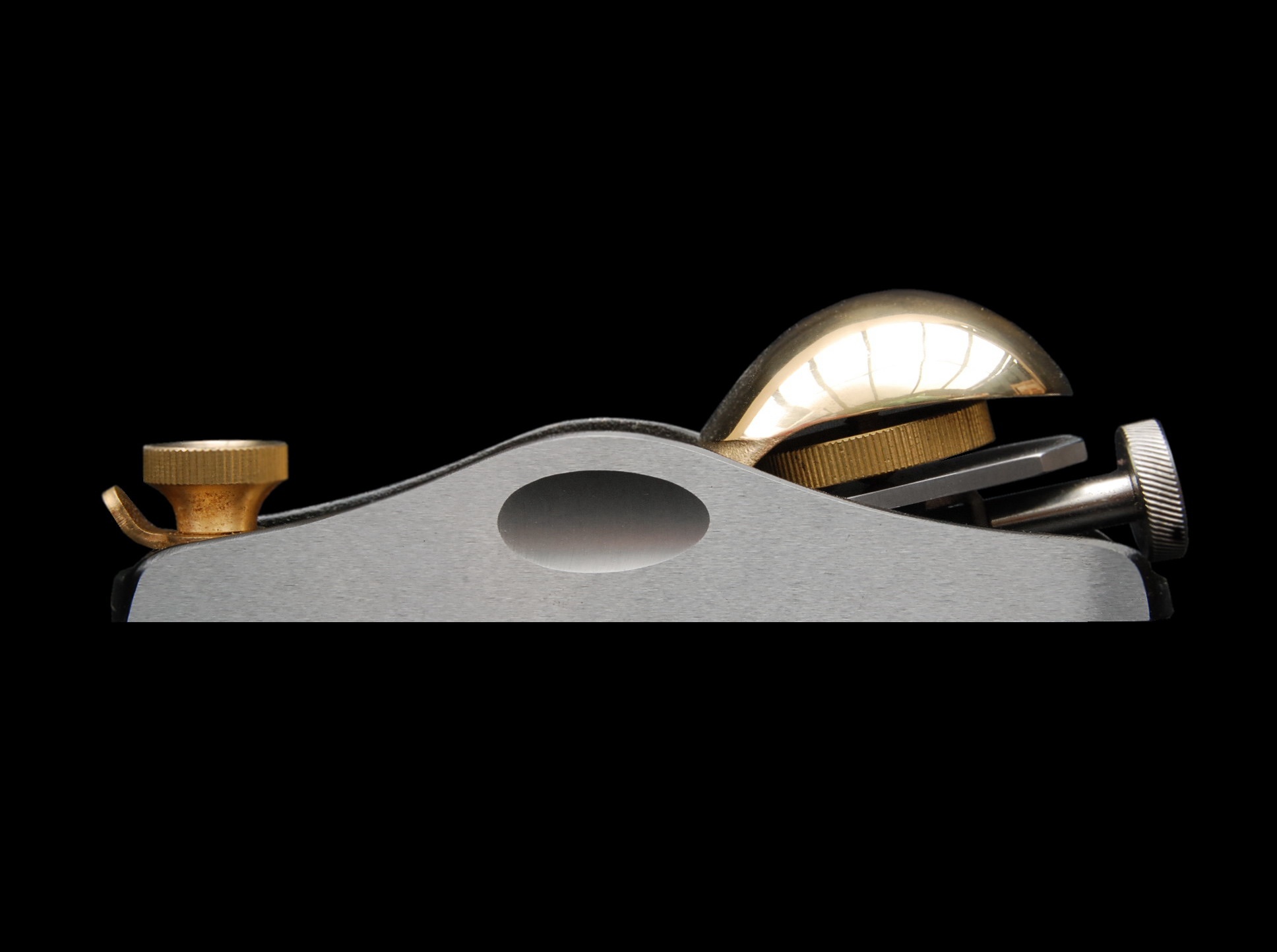
So what's the difference between the V1 and a V2 Quangsheng block planes?

The photo above shows the two side by side, V1 (left) had a fixed threaded rod with a solid brass nut that engaged a single through slot in the top of the cutting iron. V2 (right) has a screw that runs directly into the plane body, with a captive bracket that runs in a machined groove in the top of the pillar.

The new adjuster is smoother in use and has a finer thread pitch, so the cutting iron advances a shorter distance for each turn of the knob, giving more precise control over the depth of cut. It also has less tendancy to alter the lateral setting while altering the depth of cut. The bracket engages two out of 10 slots in the underside of the cutting iron - finer threads means less travel, which means you need more slots in order to use the full length of the blade.

Here's another photo showing the two threads:

Quangsheng block planes

The Quangsheng V2 standard angle block planes and low angle block planes are both supplied with a 25 degree and 38 degree cutting iron. The 25 degree blade gives a 37 degree pitch in the low angle for predominantly crossgrain and endgrain work. Although personally I don't find a huge difference from 45 to 37 I admit that it does make the tool a little easier to push through the cut. Install the 38 degree blade and you are up to 50 degrees (york pitch) for predominantly long grain work.

With the standard angle plane, the 25 degree iron gives you common pitch and the 38 degree blade takes you up to just a couple of degrees shy of cabinet pitch (60 degrees). I am very much convinced of the benefits of steeper pitches for working very hard timbers and interlocking grain.

We have also had 38 degree irons made for the V1 block planes for those that want them, as well as 50 degree irons for V2s that give 62 degree pitch in the low angle block and 70 in the standard angle. Although you are still technically planing at 70 degrees the tool functions more like a scraper plane - I'm sure that this option will be popular with instrument makers.

The rebating block plane is supplied with a 25 degree iron. As these tools are usually used more like a shoulder plane it seemed to be overkill to offer the irons in different pitches. Replacement 25 degree irons are available for both the V1 and V2 versions and steeper piches could be obtained by honing a secondary bevel.

The other tweek was changing the cap screw from flat to countersunk, which has helped to keep the cap in place whilst adjusting the iron and reduced the chance of the cap shifting in use - this modification did sneak into some of the newer V1s.

So that's it for the block planes, I'm happy that we have now got them pretty much to where I wanted them to be. I will try to get some toothed irons done though for both the block and the bench planes as I think this would expand their versatility even further.

Thursday, 16 September 2010

Standing on the shoulders of giants

Whilst researching the history of my W.B. Haigh chisel morticer I came across a copy of their 1872 catalogue on the University of Reading website. This was also the year of President Grant's re-election, the great fire of Boston, Louis Bleriot's birth, Samuel Morse's death and the first FA Cup, won by Wanderers beating the Royal Engineers 1-0 at Kennington Oval before a crowd of 2000 spectators.

By nibbling the end off the URL I found my way into a fascinating and rather large repository of such catalogues!

There are many things to tickle the interest of the casual observer in these publications, the language is fascinating - 'stuff' being commonly used for timber, 'Rabbiting' still apparently in common usage in England, before it gave way to 'rebates' and 'housings', only to be perpetuated in the US and reintroduced to the UK by Norm Abram - much to the disgruntlement of those of us who are used to rebates and housings!

The other thing to strike me was how similar these machines are in design to many of their modern day counterparts - and much more solidly made. Even though they only had belt drive or hand power, the design of many recognisable machines was devised by these guys and in most cases remains virtually unchanged.

In many ways I'm sorry to part with the morticer, it really is a beautifully made thing and I would have loved to restore it to concourse condition. An icon of that fleeting moment between hand chisel morticing and the arrival of the hollow chisel morticer. Nonetheless, the decision has been made and I'll just have to get used to the concept of being a bloke who used to own a W.B. Haigh chisel morticer - made in Oldham - by men in hats.

I now know how Mr Clarkson of Brierfield felt about his wall mounted spindle moulder when he wrote on October 26th 1877: "I beg to say that I like your "wall spindle" very well.....In fact, I should not like to be without it on any consideration".

Sunday, 29 August 2010

The Atelier System

An atelier is a group of students working through a highly ordered series of activities with a master who is also a working practitioner. The system works by building knowledge and skills through a blend of research and practice, with the bias towards research in the early stages and practice in the later stages. It is common in this system for tasks from seemingly unrelated disciplines to be used to illustrate and develop skills that are pertinant to the craft being learned. Another unusual feature is that students of different years are taught together. You cannot learn a skill and learn to teach it at the same time, but revisiting a skill that you have already perfected in practice helps you learn how to teach it to others - and only when you have cracked both can you truly consider yourself a master of the skill.

This is the system employed at Rowden Farm Workshops, where David Savage and Master Craftsmen Daren Millman and Steve Perry teach enthusiastic young makers. The workshop has a powerful energy that is apparent the moment you walk through the door, it's not like the fleeting slap of a wave but more an irresistable tide of inspiration - within minutes you have a sense that you couldn't spend more than a few hours there without developing an uncontrollable urge to make an exceptional piece of furniture. This is not David's energy, nor Daren's or Steve's, they would be drained in minutes if they tried to invoke this sort of atmosphere, it comes from the students. All the masters do is direct and focus their ambition - like a lens focusing the energy of the sun to make gentle warmth into fire.

The first thing that David does is teach students to draw - life-sized and accurate. This is exactly the same starting point that Rembrandt set out from and David is adamant that if you don't have the observational skills, sense of proportion and scale necessary to draw an object as it is, then you cannot even begin to conquer the comparatively monumental task of making something that barely exists - a mere concept in your mind - three dimensionally in wood.

Here's an example of an early lesson on drawing curves:

Tuesday, 3 August 2010

Lovely Figure

For me one of the most appealing things about working with wood is that you can never be quite certain about what you will see when you cut into a piece of it. I freely admit to staring at trees and trying to envisage what the grain would look like if it were sliced in a particular way. You can have a rough idea from the species and and obvious factors like a bend in the bole will cause cathederal grain. If there is a branch sticking out you will get endgrain in the face with a knot at the centre gradually shrinking back in a cone shape to the pith that runs down the centre of the tree. When you get further into it though there are more subtle differences that can be predicted by looking at the tree in the ground.

Trees that grow out of a hillside tend to have a curve at the bottom of the bole, this produces compression timber which is valued by boatbuilders and Japanese temple builders for it's unusually high strength, it is also less stable than straight grained timber and more prone to variation caused by the elements. A heavy snowfall or high winds increase the strain on the bend, all of which causes localised variation in the width of growth rings and the resulting figure can be quite stunning. Trees that grow very close to water are prone to mineral deposits in their timber which causes flecking in the surface of the board and various fungal and viral infections can produce ripples, quilting or fiddleback grain variations.

A particular interest of mine is burrs (burls in 'murca), the cause of these is not well documented so I have been experimenting with a couple of holly trees. I pollarded them about 18 months ago which has delivered the expected vigorous regrowth. As well as shooting from the top where the branches are they have produced shoots all over the previously smooth trunks. In a couple of places I'm just letting the shoots go, but on the rest of the trees I'm removing them as they appear, replicating the activity of animals grazing on them or brushing up against them in the wild. Nipping the shoots of as soon as they appear doesn't stop them coming, a couple of months later they are back and seem to be all the more vigorous for it. I'll persevere and see which method produces the best burrs, if only to convince myself that burr formation can be managed to maximise the value of timber.

Monday, 26 July 2010

Clifton Anniversary Planes

The first delivery of Clifton Anniversary Planes arrived this afternoon and are packed up and booked for collection by UPS tomorrow. Once the sold ones have all been processed we will receive the remainder for stock. We still have one complete numbered set available, if this has not sold by the time the planes arrive we will split the set and offer them individually.

Friday, 23 July 2010

Quangsheng Block Planes

This morning we received a shipment of planes from Quangsheng. Megan has been working like a Trojan getting all the back orders processed and booking the rest into stock, so if you had one on back order it was dispatched today.

The production department managed to get all of the V2 upgrades into the low angle block plane but couldn't get the 38 and 50 degree blades ready in time for this shipment.

The V2 low angle comes with a 25 and 38 degree blade as standard, so we are sending them out with the 25 degree blades installed and the 38 degree blades will follow automatically as soon as they arrive.

The rebating and standard angle block planes have some of the V2 modifications but not the fine thread adjuster, so we have put them back up on the website as V1's and reduced the price accordingly.

Customers who had on order a V2 standard angle block plane or low angle rebating block plane will be sent a V1 spec plane and given the option to swap it (all expenses paid) for a new, full V2 spec one when the next batch arrive. We will put up separate listings shortly so that customers who want to pre-order full V2 spec rebating and standard angle blocks can do so.

Apologies for the confusion, the guys in China have worked extremely hard to accommodate us and have carried out our instructions beautifully. I managed to find a few moments to play with one of the V2 low angle block planes today and it is just the sweetest little thing in the whole world.