
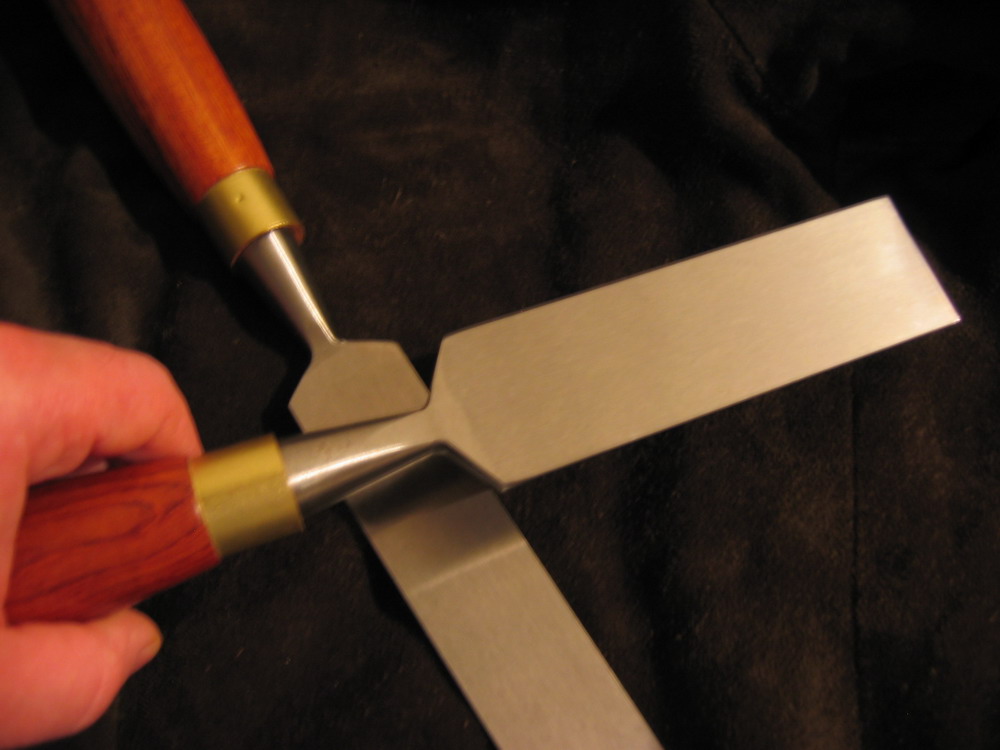
We've had a couple of questions this week about preparing chisels, specifically the hollow ground Ashley Iles chisels, so I thought it might be worth covering it here. Lets start off with what we are aiming for on the back of the blade.
The backs of chisels used for paring need to be sufficiently flat that they can take a full length cut without diving into the wood or pulling up out of it by more than 1/10 of a mm over the length of the blade. The tolerance for chopping chisels is a little wider as there is a limit to how accurately they can be held at 90 degrees to the work.
When it comes to honing, a very slightly hollow ground back is preferable to a convex or perfectly flat one, the word ‘slightly’ is key here because it still needs to be flatter than a tenth of a mm in order to remain accurate. Dead flat itself is no good because you need to remove material over the entire back of the blade in order to polish the important bit that forms the underside of the edge. Also any imperfections in your technique will tend to cause bumps or drubbing of the corners, which are self perpetuating and eventually get worse if you are working on a sharpening medium that is larger than the tool.
Bumps in the back will register first against whatever material they come into contact with and then wobble around looking for another point of contact in order to become stable. A lot of people think that bumps are an insurmountable problem, they are not, they simply call for a different technique. Nonetheless, in an ideal world, somewhere between dead flat and one tenth of a mm hollow is where we want to be.
After a great deal of time and effort the team at Ashley Iles eventually managed to achieve a reliable 0.04mm (+/-0.02mm) hollow on their cabinetmakers chisels. Although still perfectly accurate from a woodworking perspective, they are just hollow enough that when you lay the back on a dead flat surface, they only make contact at two points.
To polish the edge, lay most of the length of the tool on the sharpening media and draw it off the edge, lift off, go back to the start position, and repeat. The underside of the cutting edge is in contact with the sharpening media for the full length of the stroke, so it gets polished within a few strokes. The edge of the sharpening media also makes contact with an area inside the hollow and wears away a little material there too, so over many years of sharpening, the back will gradually get closer and closer to dead flat but never quite get there - perfect!
So a dozen or so strokes on a fine waterstone to remove any grinding marks that extend through the cutting edge when you first get them, then a couple of strokes on a fine stone after each honing and that’s it.


 Posts
Posts


