Search This Blog

Sunday, 29 August 2010

The Atelier System

An atelier is a group of students working through a highly ordered series of activities with a master who is also a working practitioner. The system works by building knowledge and skills through a blend of research and practice, with the bias towards research in the early stages and practice in the later stages. It is common in this system for tasks from seemingly unrelated disciplines to be used to illustrate and develop skills that are pertinant to the craft being learned. Another unusual feature is that students of different years are taught together. You cannot learn a skill and learn to teach it at the same time, but revisiting a skill that you have already perfected in practice helps you learn how to teach it to others - and only when you have cracked both can you truly consider yourself a master of the skill.

This is the system employed at Rowden Farm Workshops, where David Savage and Master Craftsmen Daren Millman and Steve Perry teach enthusiastic young makers. The workshop has a powerful energy that is apparent the moment you walk through the door, it's not like the fleeting slap of a wave but more an irresistable tide of inspiration - within minutes you have a sense that you couldn't spend more than a few hours there without developing an uncontrollable urge to make an exceptional piece of furniture. This is not David's energy, nor Daren's or Steve's, they would be drained in minutes if they tried to invoke this sort of atmosphere, it comes from the students. All the masters do is direct and focus their ambition - like a lens focusing the energy of the sun to make gentle warmth into fire.

The first thing that David does is teach students to draw - life-sized and accurate. This is exactly the same starting point that Rembrandt set out from and David is adamant that if you don't have the observational skills, sense of proportion and scale necessary to draw an object as it is, then you cannot even begin to conquer the comparatively monumental task of making something that barely exists - a mere concept in your mind - three dimensionally in wood.

Here's an example of an early lesson on drawing curves:

Tuesday, 3 August 2010

Lovely Figure

For me one of the most appealing things about working with wood is that you can never be quite certain about what you will see when you cut into a piece of it. I freely admit to staring at trees and trying to envisage what the grain would look like if it were sliced in a particular way. You can have a rough idea from the species and and obvious factors like a bend in the bole will cause cathederal grain. If there is a branch sticking out you will get endgrain in the face with a knot at the centre gradually shrinking back in a cone shape to the pith that runs down the centre of the tree. When you get further into it though there are more subtle differences that can be predicted by looking at the tree in the ground.

Trees that grow out of a hillside tend to have a curve at the bottom of the bole, this produces compression timber which is valued by boatbuilders and Japanese temple builders for it's unusually high strength, it is also less stable than straight grained timber and more prone to variation caused by the elements. A heavy snowfall or high winds increase the strain on the bend, all of which causes localised variation in the width of growth rings and the resulting figure can be quite stunning. Trees that grow very close to water are prone to mineral deposits in their timber which causes flecking in the surface of the board and various fungal and viral infections can produce ripples, quilting or fiddleback grain variations.

A particular interest of mine is burrs (burls in 'murca), the cause of these is not well documented so I have been experimenting with a couple of holly trees. I pollarded them about 18 months ago which has delivered the expected vigorous regrowth. As well as shooting from the top where the branches are they have produced shoots all over the previously smooth trunks. In a couple of places I'm just letting the shoots go, but on the rest of the trees I'm removing them as they appear, replicating the activity of animals grazing on them or brushing up against them in the wild. Nipping the shoots of as soon as they appear doesn't stop them coming, a couple of months later they are back and seem to be all the more vigorous for it. I'll persevere and see which method produces the best burrs, if only to convince myself that burr formation can be managed to maximise the value of timber.

Monday, 26 July 2010

Clifton Anniversary Planes

The first delivery of Clifton Anniversary Planes arrived this afternoon and are packed up and booked for collection by UPS tomorrow. Once the sold ones have all been processed we will receive the remainder for stock. We still have one complete numbered set available, if this has not sold by the time the planes arrive we will split the set and offer them individually.

Friday, 23 July 2010

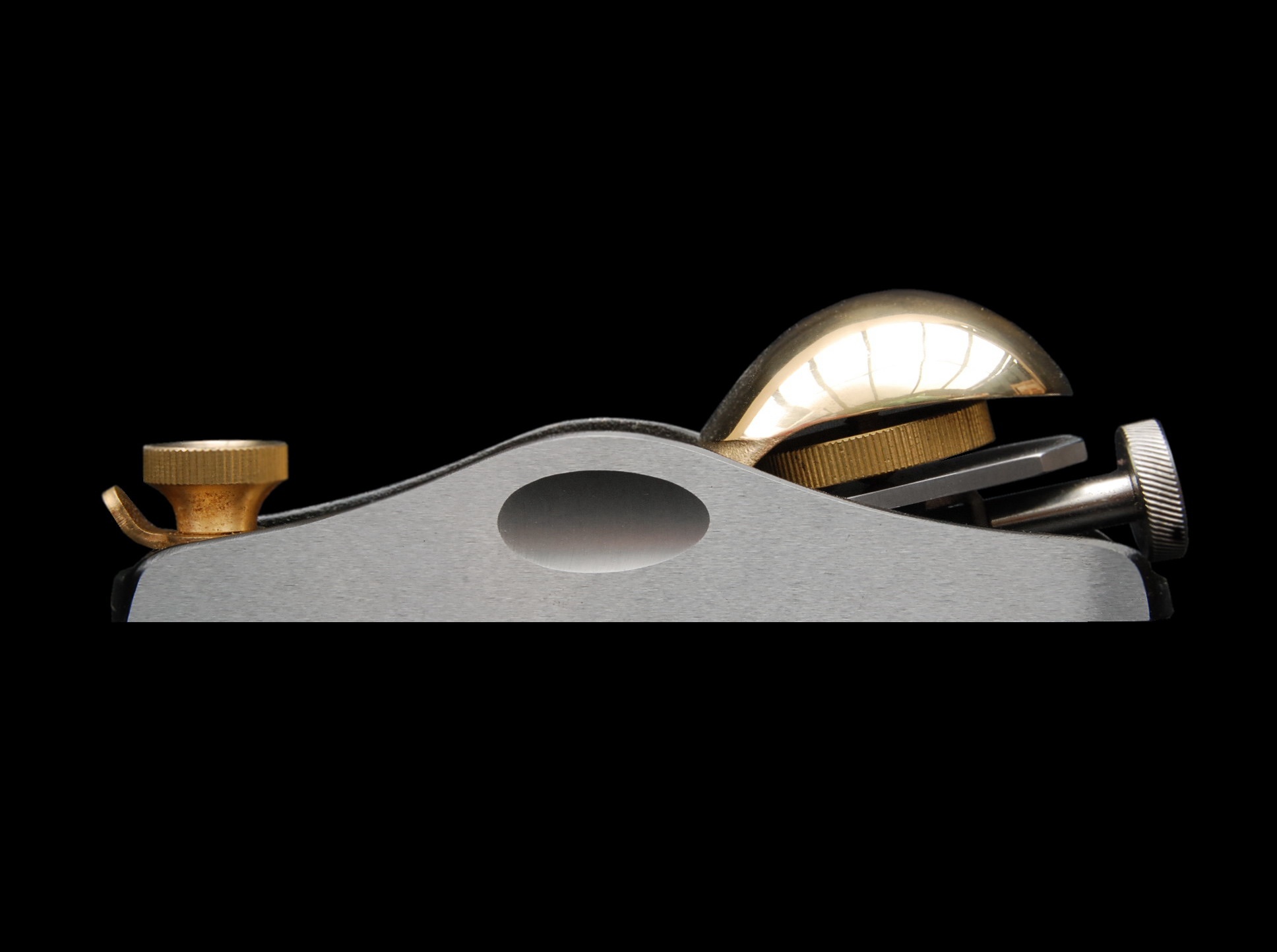
Quangsheng Block Planes

This morning we received a shipment of planes from Quangsheng. Megan has been working like a Trojan getting all the back orders processed and booking the rest into stock, so if you had one on back order it was dispatched today.

The production department managed to get all of the V2 upgrades into the low angle block plane but couldn't get the 38 and 50 degree blades ready in time for this shipment.

The V2 low angle comes with a 25 and 38 degree blade as standard, so we are sending them out with the 25 degree blades installed and the 38 degree blades will follow automatically as soon as they arrive.

The rebating and standard angle block planes have some of the V2 modifications but not the fine thread adjuster, so we have put them back up on the website as V1's and reduced the price accordingly.

Customers who had on order a V2 standard angle block plane or low angle rebating block plane will be sent a V1 spec plane and given the option to swap it (all expenses paid) for a new, full V2 spec one when the next batch arrive. We will put up separate listings shortly so that customers who want to pre-order full V2 spec rebating and standard angle blocks can do so.

Apologies for the confusion, the guys in China have worked extremely hard to accommodate us and have carried out our instructions beautifully. I managed to find a few moments to play with one of the V2 low angle block planes today and it is just the sweetest little thing in the whole world.

Wednesday, 21 July 2010

Mastercrafts Series 2 Petition

For some reason the BBC have seen fit to abort plans to film a second series of Monty Don's wonderful series Mastercrafts, shown a few months ago on BBC2. I believe that they should revise that decision and go ahead with the second series.

If you agree with me, you can join me in contacting Janice Hadlow, Controller of BBC2 and let her know your thoughts.

Sunday, 11 July 2010

A Visit to David Charlesworth

David Charlesworth

I dropped in to visit to David Charlesworth's superbly appointed workshop on the beautiful Hartland Peninsula in Devon last week. David and his students were examining the task of sawing to a line. David has a painstakingly methodical approach to woodworking that drives some people nuts, however the result of his academically thorough analysis is often a simple 'now-why-didn't-I-think-of-that-before' alteration of technique that saves a bunch of time and effort. Here's an example:

When sawing to a line you normally rest the saw on the compressed side of the cut. If you are holding the saw with a light touch, have the timber perfectly horizontal in the vice and keep the blade perpendicular to the workpiece, the saw drops in diagonally during the first couple of strokes and the left hand side of the kerf proceeds along the line.

Rob Cosman advocates starting the saw on the solid timber adjacent to the knife line to take advantage of the way it naturally moves along the path of least resistance until it reaches the mark like this:

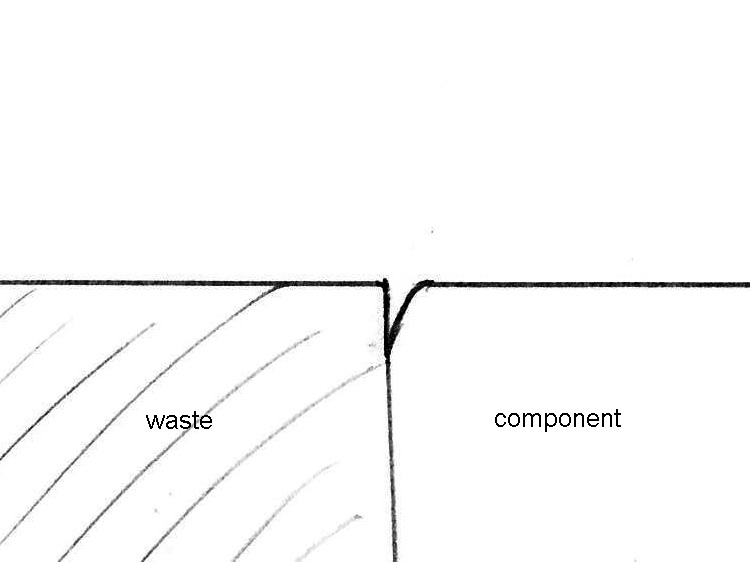
Now consider a situation where you are forced to cut on the uncompressed side of the knife line - for example cutting dovetail pins that have been marked out using the tail board as a template:

If you try to balance the saw on the waste it will naturally want to fall towards the unsupported side and you will end up cutting the component rather than the waste.

One solution that David picked up from Robert Ingham is to offset the template component to compensate at the layout stage. The amount of offset required varies depending on the kerf of your saw and the angle of your dovetails but Robert's rule of thumb is to have the tail board overhanging towards you by about 1.5mm.

The alternative method that David and I arrived at was to mark out on the line that you want to cut and then lay a chisel into the layout line to guide the saw for the first couple of strokes until the cut is established. Metal on metal is not ideal, so making a simple wooden chisel from something harder than the workpiece for the purpose would be the best solution.

Because the fibres on the bevel side of the cut have merely been compressed rather than cut, they can be made to expand back to their original position with the application of a dab of water after the joint is assembled, indeed the fact that they are compressed makes for easier assembly and a reduced chance of damaging the edge during the process:

David runs short 5 day courses throughout the spring and summer and a long 12 week course starting in September.

Thursday, 1 July 2010

And the FAMAG quiz winner is...

FAMAG

Many thanks to all who took part in our FAMAG quiz, the response was fantastic and the standard of entries very high so we did end up having to draw a name out of a hat.

Before we announce the lucky winner here are the correct answers:


  1. Who invented the Forstner Bit and when? Benjamin Forstner - 1874.

  2. What are the smallest and largest diameters of bits in the 3500 series? 3mm and 30mm.

  3. What do the letters F, A and M stand for in FAMAG? Friedrich August Mühlhoff.

  4. Should a plug cutter ideally be used in the middle of a board or close to an edge? Close to the edge.

  5. I want to bore through timber, thin metal and brickwork in a single pass, which series of FAMAG bits should I use? FAMAG 2183 Multi-purpose bits.

  6. What range of bit sizes will a 2202.000 Vario countersink fit?3mm and 8mm.

  7. FAMAG drill bits

  8. The photo above shows a set of hollow Bormax forstner bits that allow the centre pin to be replaced with a standard drill bit. In what situation would this be useful?Drilling a hole at an angle.

  9. Bormax3 are the only carbide tipped forstners in the world that can be used safely in which type of drill? Freehand.

  10. I want to drill a hole in some Lignum Vitae, should I use CV or HSS-G bits? HSS-G.

  11. In which German town have FAMAG been continuously producing drill tooling since 1865? Remscheid.


And so, without further ado...

The winner of the Workshop Heaven FAMAG Quiz is... Alastair Hislop!

Congratulations Alastair and well done to all who entered.

Monday, 28 June 2010

Clifton Anniversary planes update

Clifton Planes

News just in from Sheffield - The first of the Clifton Anniversary planes are nearing completion and will ship in the next couple of weeks.

The planes are having the final touches applied - etching the cutting irons with the number of the plane that they will be supplied with. Planes that have been pre-ordered already will be dispatched first, the remainder will follow a week or so later.

The factory have asked us to supply them with Shield Technology VanGuard Anti-Rust Coating to provide extra protection for these tools as some of them may be stored for a long period of time.

We were lucky enough to grab an additional allocation of planes, so we still have one or two of each size available.

Monday, 21 June 2010

Carpe Diem

Workshop Heaven Special Offers

Amid speculation as to whether the Chancellor of the Exchequer will raise VAT to 20% in tomorrow's budget (Tuesday 22nd of July), we have extended our Father's Day promotion on all British made products until after the announcement. It would be pointless for me to change all the prices and then have to change them again 24 hours later. So if you are thinking about a Clifton Plane, Atkinson Walker Sawblade or some Ashley Iles Chisels, sieze the day!

Thursday, 17 June 2010

FAMAG Quiz!

FAMAG drill bits

Welcome to the Workshop Heaven FAMAG Quiz. Answer the following ten questions to win a bottle of bubbly and a selection of FAMAG goodies! The marks are shown after each question. In the event of a tie, names will be drawn from a hat by our new Sales Manager, Chris, when the competition closes on the 30th of June. The winner will be reported here and informed by email.

Questions:

1) Who invented the Forstner Bit and when? (2 marks)

2) What are the smallest and largest diameters of bits in the 3500 series? (2 marks)

3) What do the letters F, A and M stand for in FAMAG? (3 marks)

4) Should a plug cutter ideally be used in the middle of a board or close to an edge? (1 mark)

5) I want to bore through timber, thin metal and brickwork in a single pass, which series of FAMAG bits should I use? (1 mark)

6) What range of bit sizes will a 2202.000 Vario countersink fit? (1 mark)

FAMAG drill bits

7) The photo above shows a set of hollow Bormax forstner bits that allow the centre pin to be replaced with a standard drill bit. In what situation would this be useful? (1 mark)

8) Bormax3 are the only carbide tipped forstners in the world that can be used safely in which type of drill? (1 mark)

9) I want to drill a hole in some Lignum Vitae, should I use CV or HSS-G bits? (1 mark)

10) In which German town have FAMAG been continuously producing drill tooling since 1865? (1 mark)

To submit your answers, please use the contact message form at Workshop Heaven.