Search This Blog

Wednesday, 10 November 2010

Karl Jenkins, The Armed Man: A Mass for Peace


Last weekend my wife and I were lucky enough to be given a pair of tickets to see Karl Jenkins' masterpiece The Armed Man performed at the Royal Festival Hall and conducted by the man himself. The mass was commissioned by the Royal Armouries in 2000 to mark the end of a violent millennium and create a legacy of peace and hope for the future. Poignantly it was destined to be released on the 12th of September 2001, which turned out to be a day when we all needed peace and hope like never before.

Usually when I listen to classical music I tend to enjoy it from the wood up, I marvel at the depth, richness and complexity of sounds that a really beautiful instrument produces (hearing a Stradivarus live is a very special way to spend an evening). I like to consider the time and pride that went into preparing the very best timber, the luthiers experience and judgment in selecting it and then shaping the components with a degree of skill and perfectionism that few can match, instrument making really is precision work at its absolute finest.

Add to that the innumerable hours of practice that each person in the orchestra has invested to master their instrument and learn to play it as a part of a perfectly orchestrated team. Then you need a genius, a one off in each generation who has the imagination, vision and intellectual capacity to bring all of this endavour to bear and you have the essance of mankind distilled into a sucession of fleeting sounds that can make you smile, or cry, or fall in love with the flick of a baton.

Our huge thanks to our friends Mark and Donna for letting us have the tickets (they were really good seats too).


Tuesday, 9 November 2010

The 5 Minute Guide to Axes

There is a wealth of information about axes on the internet, but here's a 'quick n dirty' bullet pointed guide that gives you as much info as possible in the briefest form I could manage. If you still have questions please feel free to drop me a line and I'll do my best to help.


Types of Axe

Felling Axes: Thin blades for slicing through the fibres of the timber.

Splitting Axe: Axes with fat triangular heads for driving timber apart along the fibres.

Universal: Halfway between a felling axe and a splitting axe and surprisingly effective at both jobs.

Hatchet: Small highly accurate tools for trimming and fine splitting.

Blade Shape

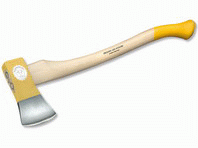
Broad: Broad faced felling and universal axes tend to work better on softwoods like pines and firs.
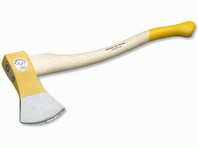


Narrow: Blades with a short cutting edge concentrate the power and are generally better for harder timbers.


Length vs. Mass

The power of an axe blow is a function of the head weight, the handle length and the amount of energy the user puts into the swing.

Heavy head: Lots of power and momentum, takes more effort to use.

Light head: Easy to wield, but less effective.

Long handle: Multiplies the energy of the swing

Short handle: Greater accuracy

A big heavy head on a long handle with a skilful and fired up user (eg OX 440 H-2708 Competition Sport Axe) will make the maximum amount of progress in the minimum amount of time but is exhausting to use.

A relatively light head with a long handle (eg OX 16 H-1008 Iltis Canadian Felling Axe ) will give the most efficient transfer of the users energy into cutting power but may require practice to control.

A relatively heavy head on a short handle (eg OX 395 E-601 Carpenter’s Bundle Axe) gives the best possible accuracy.

A relatively light head on a short handle (eg OX 25 H-0806 Harz Pattern Universal Axe) is light to carry, easy to wield and accurate, although the size of workpiece that can be tackled is limited.

Handle Materials


Ash: Has a very high strength to weight ratio (which is why it was used to make the frame for the Wright Flyer and still is used to frame cars like the Morgan +4). A very traditional timber for axe handles its only drawback is that when it does break it tends to break in two.

Hickory: (shown above) is massively strong stuff, good quality Hickory (the best comes from North America) is capable of 3-4 times the physical loading of Ash. It also has a very long fibre structure which means that it splinters apart but is unlikely to break fully in two.

Fibreglass: Modern synthetic handles are virtually unbreakable, immune to the cold and wet and on paper they seem the obvious choice. They just don't have quite the same feel as wood though.

Sharpening

Acute angles: (typically found on felling axes) are sharper but more delicate.

Obtuse angles: (typically found on splitting axes) will be more durable.

Axes should be sharpened with convex bevels, which are stronger than flat or hollow ground ones.

Axes should never be reground on a powered grinder. If you get a big ding in the edge an aggressive file is the best way to remove it.

Safety

No steel on steel. Hitting two pieces of hardened steel together can cause chips of steel to fly off. By all means drive aluminium, plastic or wooden wedges with the back of a splitting hammer or hit steel axe heads or wedges with a polyamid or wooden mallet, but no steel on steel please.

Eye protection: Speaks for itself, big impacts, unpredictable materials, one pair of eyes.

Gloves: Not woolly ones, proper rubberised work gloves that give an effective grip and provide some protection against splinters.

Check your equipment: Make sure that the head is securely fixed to the handle and check the handle for any signs of damage before starting work – every single time.

If it doesn’t feel safe don’t do it: Think about where the axe will go if you miss or the material moves, if a body part features anwhere in the plan for stopping the axe – make a new plan. A knee high chopping block is an essential safety aid for chopping.

Thursday, 4 November 2010

Postage Charges Reduced


We have recently started franking the parcels that we send out by Royal Mail (usually anything under 2kg). Although it is delivered by the same postie, franked mail runs through an entirely seperate system within Royal Mail, so it is faster as well as being a bit cheaper.

We have now adjusted the shipping calculator, so all of the prices are lower than before - some by a considerable margin. It doesn't make much of an advertising headline because the rates are individually calculated according to the weight of the order and destination, but it will still save our customers a bit of money which can only be a good thing.

By the way - using the second class service where available you can save even more and if your order is placed before 2pm you still have a 90% chance that your package will arrive the next day.

Tuesday, 2 November 2010

Saw Handle Instructions

Woodworking saws

Thanks to some very generous assistance from Aiden (The Tiddles) of UK Workshop, we finally have handle plans available for the Atkinson Walker saw kits. Thank you to those who have been waiting for them.

Download saw handle templates here.

A step by step guide how to make your saw handle can be found here.

The guide to sharpening and using your new saw is here.

For an intermediate woodworker, these kits are great fun to make and you end up with a fantastic set of saws that you will enjoy using for many years. They also give you an appreciation of how much work goes into producing top-end handmade saws and perhaps even a few new skills that you can transfer to other projects.

Thursday, 28 October 2010

Supersize Me!

Narex mortice chisel in use


The new 12mm, 14mm and 16mm Narex mortice chisels arrived the other day (along with some new sizes of the Narex bevel edged chisels) and being an inquisitive sort I had to have a play!

I had expected the 16mm mortice chisel to be a bit of a brute to wield, it is after all an enormous chunk of steel, but in its working position the weight is all borne by the workpiece. Making the initial cuts with the blade pinched low down between thumb and forefinger, you can feel the chisel start to 'swoon' if you get too far from vertical, when it feels weightless, you know it's perpendicular.

The intial cuts suggested that making progress wasn't going to be a problem, 3mm at a time into English walnut with nothing more substantial than a sharp tap with the mallet.

Having cleaned out the first layer of chips to create the shoulders of the mortice I moved on to heavier blows and the chisel just ate its way in. A handy tip I picked up from Jacob Butler is to chop through the waste rather than trying to clear it as you go. This saves a bunch of time and preserves the shoulder as all the force is going downwards. The chips gradually get more and more finely chopped too, so most of them will fall out when you turn the workpiece over and give it a sharp tap on the bench, especially if you made a cut lengthwise through the middle of the waste with a broad bevel edged chisel first. What little did need levering out at the end was done by using the kevlar reinforced head of the clamp as a fulcrum, again to preserve the crisp finish.

Considering that this was all done with the factory finish on the cutting edges I was pleasantly surprised and impressed with both the efficacy of the tool and the results. A little judicious honing of the primary cutting edge and the first inch or so of the sides will no doubt yield further performance.

If you haven't tried cutting mortices by hand I can thoroughly recommend it. Morticing machines have their place and if you are doing production work they are invaluable, but if you are only doing a few slots to cut then chiselling them is a quick, inexpensive and rewarding alternative.

Tuesday, 26 October 2010

Sneak Previews

Our New Continental Hand Stitched Rasps will be available shortly, there has been a minor delay as we altered the handle design slightly at the last minute. That said the results will be beautiful and it's better to get them absolutely spot on from the outset than rush them through and have to make changes later.

The new range of Narex Cabinetmakers Chisels are in production and will be available shortly. The edges are finer than the originals and the backs are correctly hollowed by around 6 thou in the length so they are very quick to prepare using 100 micron film and rapidly come into tolerance for fine work. The steel is the same bainitic chrome manganese steel used on the originals, austempered to RC59 for a deep even hardness and very high strength. The handles will be hornbeam, stained black with gold lettering and brassed ferrules.

Coming soon - the new Quangsheng Low Angle Jack Plane! This is the first photo we have of this new addition to the Quangsheng range and although it's unlikely to be here in time for Christmas, I'm sure it will prove to be a very popular tool.

The mouth is adjustable by means of a movable front sole, and depth of cut adjustment comes courtesy of a smooth and precise V2 mechanism similar to that found on the new Quangsheng block planes.

Wednesday, 13 October 2010

New Quangsheng Bench Planes

Quangsheng planes

The new Quangsheng bench planes are now available and will completely replace the original versions once existing stocks run out. The pressed steel lateral adjuster has been replaced with a fabricted one made from steel and brass with a guide bearing. The yoke that advances the iron is a little more meaty and we have switched from grasstree handles to Chinese rosewood. The lever cap is cast stainless with a fine brushed finish. We have stuck with the original 40cr cast steel bodies and T10 cutting irons as we believe that they are more highly specified than any of the alternatives.

Quangsheng bench plane

Wednesday, 6 October 2010

Time well spent

Time spent with good friends around a fire is invariably some of the higest quality time you will spend in your life. If you happen to poke a few bars of really nice steel into the fire and then bash them around - well, lemmetelya, it just gets better and better.

We popped in to visit custom knifemaker Chris Grant on the edge of the Cairngorms this week and once we had got over the spectacular scenery:

We settled into a couple of evenings of hard but rewarding prototyping. This is both enjoyable and really hard work at the same time. Commercial decisions need to be made on the spot and although the results can be seen almost immediately, time is very limited so the pressure to get those decisions right every time goes through the roof. It's a mentally demanding process but the results are well worth a thousand mile round trip and a spot of pressurised thinking.

First up was an idea that I have been mulling over for some time - a marking knife that can be presented perfectly flush to a left or right corner and naturally balances correctly in either position, can be rolled or drawn over an edge or surface and is possibly the wierdest looking but simultaneously the most 'now why didn't anyone else figure this one out before' idea that my twisted mind has ever wrought. Can it be made commercially? I have no idea as yet, but seeing the idea fleshed out in both O1, piano wire and cut-throat razor steel certainly brings things a step closer.

Yes, the photo doesn't give much away - but at this stage of production it would be foolish to do so. Suffice to say I am very excited about bringing this product to market.

Next was a forged carving knife for green woodworking - we used the same razor steel for this and it takes probably twice the effort to forge that O1 would (guess who was swinging the hammer to get this one from round to flat) - "s'your spec pal, you've tae bash tha bugger oot!!!" People talk about steel 'flowing under the hammer' well this stuff flows like a glacier on a cold day, even at 900 degrees C, but it was well worth breaking a sweat over - I have seen edges that would slice free hanging tissue paper before but it's still very impressive. The next step would be ball bearing steel which is only just forgable by hand if you've got really big arms and a chip on your shoulder, but may just be viable under mechanised production. I've gone for the longest blade I thought was viable on the principle that you can always make things shorter, but we will see how it goes once it's handled.

While we were at it, I thought that the most ultimate, ultra-gucci spoon knife in the world would be a lovely thing to do, so here we have a differentially hardened white paper steel (which I also learned began as mass produced tamahagane) spoon knife blade, complete with hamon line. It was a right little tinker to make and took hours to get right but if your smith can knock one of these out you know you are dealing with someone who really knows their business, £125 a pop unhandled if anyone feels the need. Here it is roughed out and quickly etched to find the hamon, once fully polished I have no doubt that this will become one of my my most treasured posessions. I went for a longer shank than usual as this allows you to swoop in for the really low cuts that enable you to hollow oval shapes as well as circular ones.

Last of all was something for Her indoors, a stock removal Santoku from AE 1095/15N20 Damascus which turned out better than any of us could have imagined.

Stock removal is a cheaper manufacturing method than forging but more wasteful in terms of raw materials, forging would however have produced a larger blade. Nonetheless, this little chap will see some serious testing once it is handled and it will be enlightening to see how it performs as an everyday kitchen knife. Updates to follow.

Chris is shortly going to be moving workshops, so if you want anything made it's probably best to be both quick in placing your order and prepared to wait a while for it. I can however give my personal guarantee that he will stop at nothing to ensure that the quality of your finished item is second to none in the world.

Saturday, 25 September 2010

Quangsheng V2 Block Planes

Quangsheng block planes

So what's the difference between the V1 and a V2 Quangsheng block planes?

The photo above shows the two side by side, V1 (left) had a fixed threaded rod with a solid brass nut that engaged a single through slot in the top of the cutting iron. V2 (right) has a screw that runs directly into the plane body, with a captive bracket that runs in a machined groove in the top of the pillar.

The new adjuster is smoother in use and has a finer thread pitch, so the cutting iron advances a shorter distance for each turn of the knob, giving more precise control over the depth of cut. It also has less tendancy to alter the lateral setting while altering the depth of cut. The bracket engages two out of 10 slots in the underside of the cutting iron - finer threads means less travel, which means you need more slots in order to use the full length of the blade.

Here's another photo showing the two threads:

Quangsheng block planes

The Quangsheng V2 standard angle block planes and low angle block planes are both supplied with a 25 degree and 38 degree cutting iron. The 25 degree blade gives a 37 degree pitch in the low angle for predominantly crossgrain and endgrain work. Although personally I don't find a huge difference from 45 to 37 I admit that it does make the tool a little easier to push through the cut. Install the 38 degree blade and you are up to 50 degrees (york pitch) for predominantly long grain work.

With the standard angle plane, the 25 degree iron gives you common pitch and the 38 degree blade takes you up to just a couple of degrees shy of cabinet pitch (60 degrees). I am very much convinced of the benefits of steeper pitches for working very hard timbers and interlocking grain.

We have also had 38 degree irons made for the V1 block planes for those that want them, as well as 50 degree irons for V2s that give 62 degree pitch in the low angle block and 70 in the standard angle. Although you are still technically planing at 70 degrees the tool functions more like a scraper plane - I'm sure that this option will be popular with instrument makers.

The rebating block plane is supplied with a 25 degree iron. As these tools are usually used more like a shoulder plane it seemed to be overkill to offer the irons in different pitches. Replacement 25 degree irons are available for both the V1 and V2 versions and steeper piches could be obtained by honing a secondary bevel.

The other tweek was changing the cap screw from flat to countersunk, which has helped to keep the cap in place whilst adjusting the iron and reduced the chance of the cap shifting in use - this modification did sneak into some of the newer V1s.

So that's it for the block planes, I'm happy that we have now got them pretty much to where I wanted them to be. I will try to get some toothed irons done though for both the block and the bench planes as I think this would expand their versatility even further.

Thursday, 16 September 2010

Standing on the shoulders of giants

Whilst researching the history of my W.B. Haigh chisel morticer I came across a copy of their 1872 catalogue on the University of Reading website. This was also the year of President Grant's re-election, the great fire of Boston, Louis Bleriot's birth, Samuel Morse's death and the first FA Cup, won by Wanderers beating the Royal Engineers 1-0 at Kennington Oval before a crowd of 2000 spectators.

By nibbling the end off the URL I found my way into a fascinating and rather large repository of such catalogues!

There are many things to tickle the interest of the casual observer in these publications, the language is fascinating - 'stuff' being commonly used for timber, 'Rabbiting' still apparently in common usage in England, before it gave way to 'rebates' and 'housings', only to be perpetuated in the US and reintroduced to the UK by Norm Abram - much to the disgruntlement of those of us who are used to rebates and housings!

The other thing to strike me was how similar these machines are in design to many of their modern day counterparts - and much more solidly made. Even though they only had belt drive or hand power, the design of many recognisable machines was devised by these guys and in most cases remains virtually unchanged.

In many ways I'm sorry to part with the morticer, it really is a beautifully made thing and I would have loved to restore it to concourse condition. An icon of that fleeting moment between hand chisel morticing and the arrival of the hollow chisel morticer. Nonetheless, the decision has been made and I'll just have to get used to the concept of being a bloke who used to own a W.B. Haigh chisel morticer - made in Oldham - by men in hats.

I now know how Mr Clarkson of Brierfield felt about his wall mounted spindle moulder when he wrote on October 26th 1877: "I beg to say that I like your "wall spindle" very well.....In fact, I should not like to be without it on any consideration".